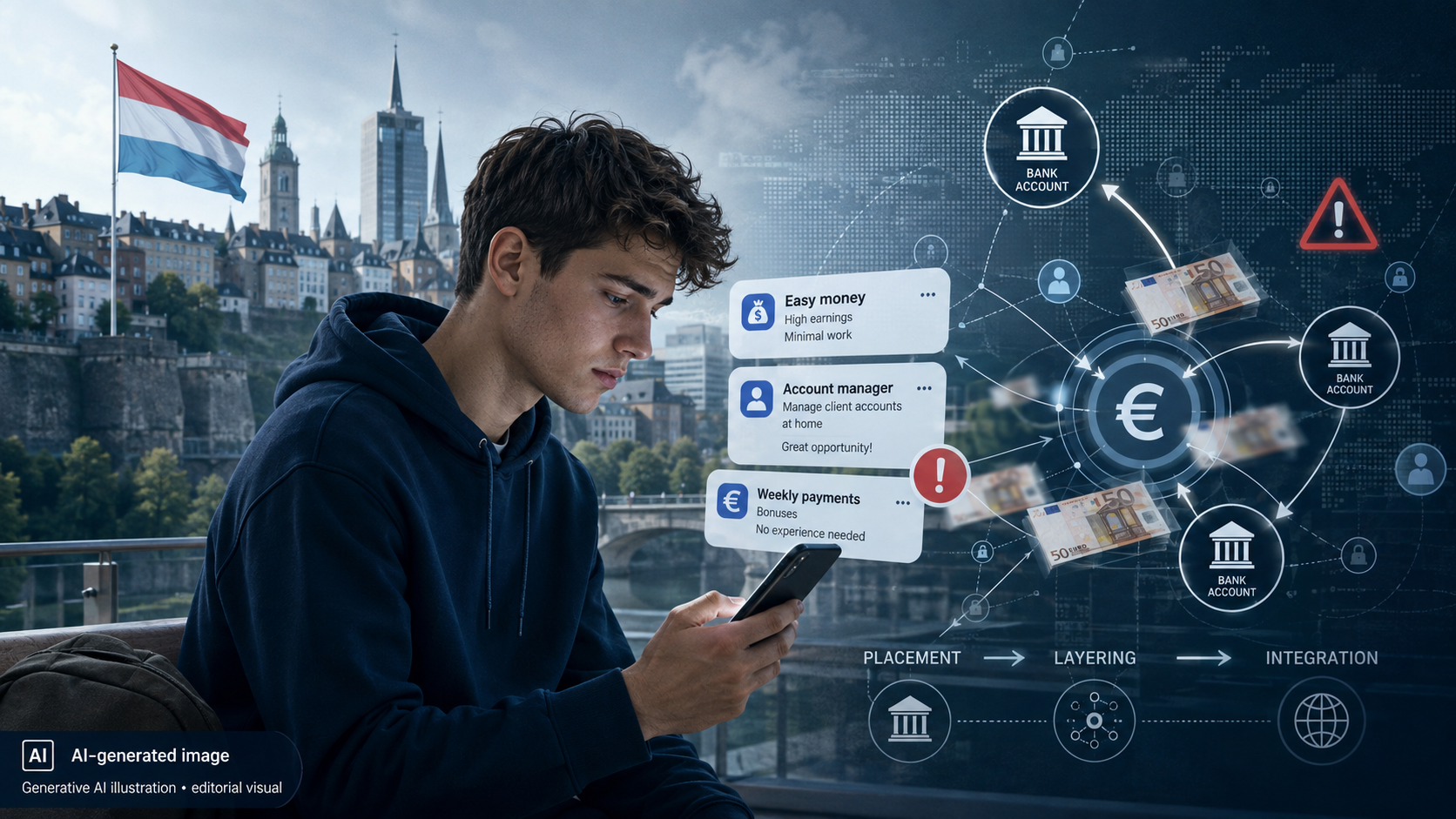
In recent years, an increasing number of young people across Europe have become involved in money laundering schemes without fully understanding the consequences. One common method utilised by criminal networks is the deployment of “money mules”. Europol defines these individuals as persons who receive illicit funds into their personal bank accounts and subsequently transfer them to secondary accounts or withdraw them as cash, in exchange for a financial incentive.
From an anti-money laundering (AML) perspective, the mule’s role is structurally critical. Criminals rely heavily on these individuals to introduce illicit proceeds into the legitimate financial system, effectively concealing the link between the original predicate offence, such as fraud, cybercrime, or drug trafficking, and the ultimate beneficiary. This layering technique is a core typology documented across reports by the Financial Action Task Force/Groupe d'action financière (FATF/GAFI), Europol, and Eurojust. While some young people knowingly participate, many are misled by recruiters who obscure the criminal nature of the activity.
The Luxembourg Context and Recruitment Tactics
In Luxembourg, the Police Grand-Ducale has issued targeted warnings indicating that money mule recruitment was on the rise. Criminals increasingly leverage social media platforms such as Instagram, Snapchat, and WhatsApp to approach potential prospects. Recruiters typically advertise what appears to be a legitimate, low-effort employment opportunity, frequently marking the role under titles such as “financial agent” or “account manager.” The mandated tasks generally involve receiving funds into a personal bank account and forwarding them to another account or withdrawing them as cash. However, these transferred funds almost invariably originate from organised criminal activities including fraud, cybercrime, narcotics, or human trafficking, with the mule’s account acting as a conduit to obscure the criminal origins of the funds.
The scale of the problem is considerable. Globally, the ninth edition of the European Money Mule Action (EMMA), coordinated across 26 countries identified 10,759 mules, and 474 recruiters, culminating in 1,013 arrests worldwide At a domestic level, Luxembourgish law enforcement has stepped up counter measures: the Police Grand-Ducal recently arrested five suspected individuals suspected for permitting criminal syndicates to utilise their bank accounts and bank cards for illicit transit flows. A further notable example occurred in June 2026, when the Luxembourg Public Prosecutor’s Office announced that their judicial investigation into the €61 million Caritas embezzlement case had expanded internationally. The investigation, which was said to have entered into its fourth phase, resulted in 19 arrests and specifically implicating nine suspected mules tasked with laundering the stolen funds across multiple European jurisdictions.
Socio-Economic Vulnerabilities and Exploitation
Young demographics are specifically targeted because of their high levels of activity on digital platforms and their susceptibility to promises of quick financial gain. From a criminological perspective, recruiters deliberately exploit financial strain, characterised by limited financial security, rising student living costs, and restricted access to formal credit markets.
In Luxembourg, youth unemployment reached 20.2% in 2024, and according to STATEC, nearly one in four children lives in a household at risk of poverty. Beyond direct economic pressure, recruiters exploit aspirations for social status and luxury consumer goods, particularly within demographics where visible consumption is linked to peer recognition. Perpetrators normalise the illicit activity as freelance financial work. Furthermore, Europol’s Internet Organised Crime Threat Assessment (IOCTA) documents a sophisticated grooming dynamic, noting that recruiters often spend weeks building rapport and trust with a target before requesting direct account access.
Legal and Financial Consequences
The ramifications of operating as a money mule are severe and frequently underestimated by participants. Psychologically, young mules often exhibit a short-term gratification bias, prioritising immediate financial rewards while heavily discounting long-term legal exposure. Upon detection by authorities, many attempt to neutralise culpability by claiming ignorance or portraying themselves as victims of deception.
Legal Precedent under Luxembourg Law:
Under Article 506-1 of the Luxembourg Penal Code, the law requires the presence of criminal intent. Specifically, the updated Article 506-1 stipulates that individuals must act “knowingly” in facilitating, assisting, or acquiring property derived from a crime. Crucially, the prosecution bears the burden of establishing that mental element. Where it is established, a conviction under this framework can result in a prison sentence ranging from one to five years and criminal fines between €1,250 to €1,250,000.
Beyond statutory criminal sanctions, being flagged for fraud-related activity triggers immediate account termination and entry of the individual’s details into industry-wide compliance blacklists maintained by financial institutions. This effectively excludes the individual from the formal financial system. For periods typically lasting up to eight years, blacklisted individuals are barred from obtaining mortgages, personal loans, and credit cards, creating severe, cascading consequences for housing, employment, and long-term economic independence.
Consequently, the Luxembourg Bankers Association (ABBL) and the Commission de Surveillance du Secteur Financier (CSSF) have both emphasised the critical need to communicate these compliance consequences more explicitly to younger demographics. In response, a specialised informational portal was launched on the lëtzfin.lu platform, backed by the CSSF, to systematically demystify the mechanics of the "Geldiesel" (money mule) phenomenon and outline operational warning signs for vulnerable youth.
Strategic Imperatives for Luxembourg
The growing money muling trend demonstrates that money laundering is no longer exclusively the domain of large financial institutions or transnational criminal syndicates. It increasingly implicates ordinary young citizens who become unwitting nodes in criminal value chains.
Luxembourg’s position as the EU’s largest investment fund domicile and a leading international financial centre makes it a structurally attractive target for money laundering networks. The FATF’s 2023 Mutual Evaluation Report acknowledged the robustness of Luxembourg’s AML/CFT framework but explicitly highlighted the ongoing need to strengthen money laundering investigations and prosecutions.
Recognizing these gaps, the Luxembourg government has designated the fight against financial crime a top priority, committing to expand the “eco-fin" department of the Judicial Police by 70 additional personnel to reach a total of 200 officers by 2030, alongside enacting legislative reforms to facilitate administrative information exchanges.
For Luxembourg to address this systemic threat effectively, a multi-stakeholder approach is required - one that pairs intensified law enforcement capabilities with robust preventative measures and a deeper, data-driven understanding of the local landscape:
- Educational Institutions: Secondary schools and tertiary institutions must integrate comprehensive AML awareness into standard financial literacy curricula. This is exemplified by regional pilot projects, such as at the Maacher secondary school, where students actively generate educational social media content to warn peers ahead of broader national press campaigns.
- Financial Institutions: Banks and fintech firms must develop targeted early-warning transaction monitoring systems tailored to detect mule-typical transaction patterns among youth-held accounts, reporting anomalies directly to the Financial Intelligence Unit/ Cellule de renseignement financier (CRF).
- Social Media Platforms: Tech companies must be held accountable for policing, detecting, and removing fraudulent job solicitations. In Luxembourg, this effort is reinforced by the Bee Secure programme, which operates as a "National Trusted Flagger" under the Digital Services Act, enabling direct, expedited alerts to large online networks regarding illicit recruitment content.
- Academic and Civil Society Research: The National Research Fund/Fonds National de la Recherche (FNR), state regulators, and competent authorities must go further in their commitments by proactively funding comprehensive academic and civil society research to map the specific psychological levers and algorithmic recruitment strategies weaponised against young demographics online, while critically evaluating the effectiveness of existing awareness-raising and prevention initiatives. Crucially, research efforts require the establishment of a localised data clearinghouse to track granular metrics such as precise age brackets, student status, socioeconomic indicators, and linguistic profiles unique to the Grand Duchy. This approach will ensure that domestic policy and public interventions are built on a rigorous, evidence-based foundation rather than generalized European assumptions.
Conclusion
The recruitment of young people as money mules represents a growing and structurally embedded challenge both within Luxembourg and the wider European landscape. Empirical evidence consistently shows that participation in money mule schemes carries devastating legal and socio-economic repercussions, including criminal prosecution under Luxembourg’s AML framework, protracted financial exclusion, and the direct facilitation of severe predicate offences ranging from drug trafficking to human exploitation. Combating this phenomenon requires more than just reactive law enforcement intervention; it demands an evidence-based approach rooted in localised empirical research to decipher exact recruitment mechanics, alongside sustained institutional investment in targeted financial education, digital literacy, and deeper cross-sector cooperation between regulators, financial institutions, and academic bodies.
Transparency and education are our best defences against financial crime. Share this article to raise awareness, and visit www.l4t.lu/en/get-involved to see how you can support Luxembourg for Transparency's ongoing advocacy work.
Sources
Europol – Money Muling prevention and awareness guide
Open websiteEuropol – EMMA 9 press release: Paper trail ends in jail time for 1,013 money mules (2023)
Open websiteEurojust – European Money Mule Action (EMMA) coordination page
Open websitePolice Grand-Ducale – Money Muling prevention page, Article 506-1 of the Luxembourg Penal Code
Open websiteInterpol – Money Muling awareness resources
Open websiteFATF – Mutual Evaluation Report: Luxembourg, September 2023
Open websiteFATF – Luxembourg country page
Open websiteMONEYVAL – Council of Europe AML evaluations
Open websiteEuropean Commission – AML Directives (AMLD4, AMLD5, AMLD6)
Open websiteCSSF – Commission de Surveillance du Secteur Financier
Open websiteABBL – Association des Banques et Banquiers, Luxembourg
Open websiteSTATEC – At-risk-of-poverty rate, Luxembourg (2025 release)
Open websiteSTATEC – Work and Social Cohesion Report 2024
Open websiteMacrotrends – Luxembourg youth unemployment rate historical data
Open website